We went to our first-ever cricket match. By the end of it, we were fans. It was the national final match, so there was a great deal of pomp: dancing girls, guys dressed up in silly suits. The referrees were delivered to the field in a helicopter. They do the wave here, and they call it the Mexican wave.
Thursday, March 19, 2009
Monday, March 16, 2009
Sunday, March 15, 2009
Saturday, March 14, 2009
Friday, March 13, 2009
Monkey Wars
There was an ongoing battle between people and monkeys at the Augrabies Falls campground, and the monkeys were winning. I think this was because the monkeys wanted one thing from the people: food. The people, meanwhile, wanted a bunch of different things from the monkeys, often all at the same time.


Some people (like me) wanted to take pictures of the monkeys playing on tents and cars.
Some people wanted to chase them off. (In between throwing sticks, these people kept shouting, "Stop pooping on my tent!")
Some people wanted to feed the monkeys.
And a few fools wanted to get them drunk. (It didn't work. They spilled all the wine.)
As confusing as human behavior must seem to the monkeys, it's clear that they're willing to put up with us. They came to visit us for breakfast and dinner, whether we invited them or not.
Melissa
Thursday, February 5, 2009
Cute Little Thieves
When I was in college, I read that vervet monkeys have three different alarm calls to warn each other of eagles, snakes, and leopards. Now that I know these animals well, I can say for certain that everything else in their communicative arsenal means, roughly, "You go over there and do something adorable while I sneak up behind the people and grab that bag of nuts."
This monkey might look like it's just hanging out on a post. But I was cooking dinner when I took this picture, and oddly enough, the monkey was one post closer to me every time I turned around.
Eating leaves? Uh-uh. This one has an eye on my bread.
I'm afraid my bread didn't survive its attentions.
It wasn't a fair contest. There were about two dozen of them and only one of me.
Melissa
Wednesday, January 28, 2009
Sociable Weavers
Sociable weaver nests can weigh up to a ton and last 100 years. The individual birds don't live that long, but their colonies can. As the weavers keep building, the weight of these nests can eventually fell a tree.


The nests provide better shade than trees (or, in this case, power poles), so animals such as wildebeests often hang out beneath them. These visitors, along with the weavers themselves, contribute organic matter to the soil. As a result, young desert plants often thrive underneath the nests.
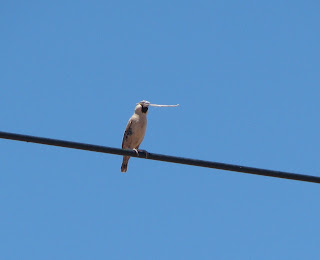
This little guy apparently doesn't think his nest is big enough yet.
Melissa
Subscribe to:
Posts (Atom)