Thursday, February 5, 2009

Cute Little Thieves

When I was in college, I read that vervet monkeys have three different alarm calls to warn each other of eagles, snakes, and leopards.  Now that I know these animals well, I can say for certain that everything else in their communicative arsenal means, roughly, "You go over there and do something adorable while I sneak up behind the people and grab that bag of nuts."

This monkey might look like it's just hanging out on a post.  But I was cooking dinner when I took this picture, and oddly enough, the monkey was one post closer to me every time I turned around.


Eating leaves?  Uh-uh.  This one has an eye on my bread.  


I'm afraid my bread didn't survive its attentions. 

It wasn't a fair contest.  There were about two dozen of them and only one of me.

Melissa

Wednesday, January 28, 2009

Sociable Weavers

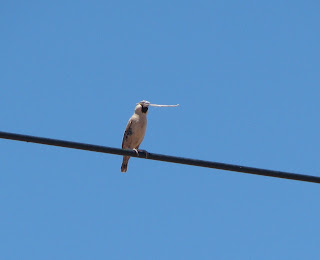
Sociable weaver nests can weigh up to a ton and last 100 years.  The individual birds don't live that long, but their colonies can.  As the weavers keep building, the weight of these nests can eventually fell a tree.

The nests provide better shade than trees (or, in this case, power poles), so animals such as wildebeests often hang out beneath them.  These visitors, along with the weavers themselves, contribute organic matter to the soil.  As a result, young desert plants often thrive underneath the nests.


This little guy apparently doesn't think his nest is big enough yet.

Melissa

Sunday, January 18, 2009

Dassie Trail

We took a hike on a trail called the Dassie Trail, a nice little desert stroll with a few challenging moments.  

Our destination was the Moon Rock, which you can see against the horizon on the righthand side of the photo below.


When we came across a safety sign in the middle of nowhere, Andy just happened to disobey it.  (If you can't read the sign, it says, "Potholes may be hidden by plants.  Don't step on the old, dead reeds.")

These klipspringer stood completely still for several minutes as we approached them, and then they bounced away.  These were the first we saw, but not the last.  Their habit of standing watch on top of big rocks made them some of the easiest wildlife to spot in the park.

For the benefit of all the geologists in the family, we snapped some pictures of neat rocks.


And then we climbed the Moon Rock.  From the top, the view stretched pretty much forever.  

On the way back to camp, we had to go wading a bit.  

Incidentally, I got the car stuck on this exact spot a day later.  If Andy hadn't done a Hercules and picked up the back end, we might never have made it home.

Melissa 

Thursday, January 15, 2009

Augrabies Falls

The word "Augrabies" comes a from a Khoi phrase meaning "Place of great noise."  The khoi used to avoid the waterfall because they believed it was the home of a monster.  


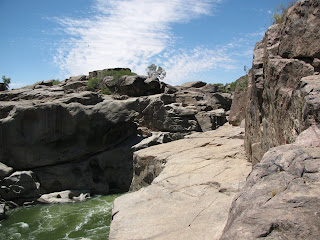
On our first full day in the park, Andy and I wandered around the falls, admiring the views and the neat potholes in the rocks.


When we stopped for lunch, Andy invented a new food:  hard-boiled eggs wrapped in slices of ham.  Very tasty.


Dozens of lizards ran around us while we were eating lunch.  I think they were after our crumbs. They were not shy at all.  One of them ran up on my shoe. 


Melissa

Monday, January 12, 2009

Rock Dassie

These things look like rodents, but they're actually related to elephants.


Melissa


Saturday, January 10, 2009

Mongoose

At the Augrabies falls campground, these guys checked out the empty braai pits almost every morning.  


Melissa

The Drive to Augrabies

On the second day of our trip, we drove up to Augrabies National Park.  On the way, we stopped in the town of Calvinia.  Not for the first time, I was glad I'd given up being a vegetarian before coming to South Africa.  We bought some tasty lamb chops and sausages at this braai (barbecue) place.


We also went into the town's museum, which is the building behind the train engine in this photo.  It had nice displays about the San, who were the earliest known inhabitants of this region; the Boer settlers who moved in later; and the sheep farming that supports the region today.  It also had a whole room dedicated to a set of quadruplets who were born in the town some time ago.


Back on the road, we passed a forest of aloe trees, which are called quiver trees because the San used to hollow out the branches and use them as quivers for their arrows.


We also stopped at this farmstall/junk shop/souvenier shop/cafe:


In spite of all the stopping, we did manage to reach our destination.  We caught our first glimpse of Augrabies Falls, the sixth largest waterfall in the world, just as it was getting dark.  We didn't have time to hang around and take many pictures that night, though, because we had to go set up camp.   I'll post the next day's pictures of the area soon.


Melissa